
AI Receptionist for Small Business:
Every Call, Text and Email Answered in Seconds
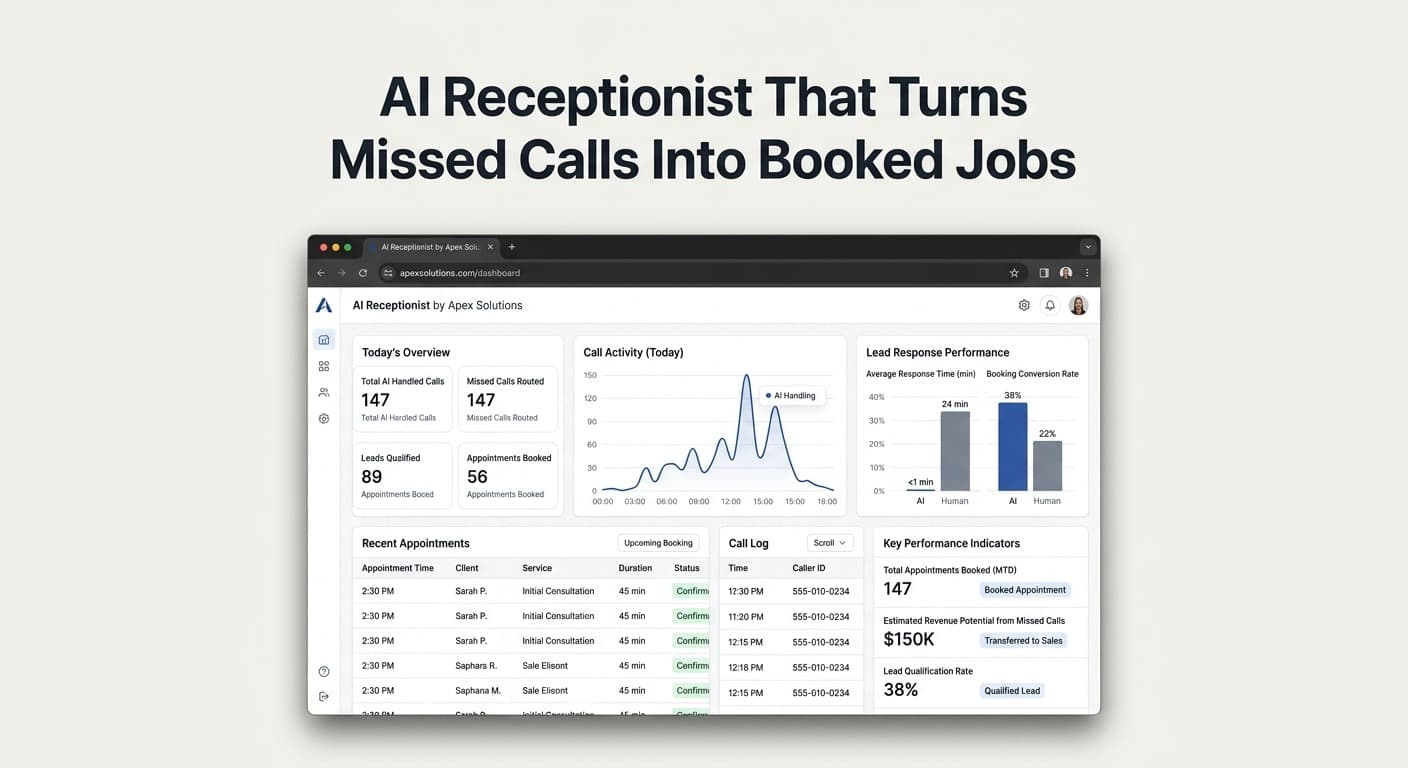
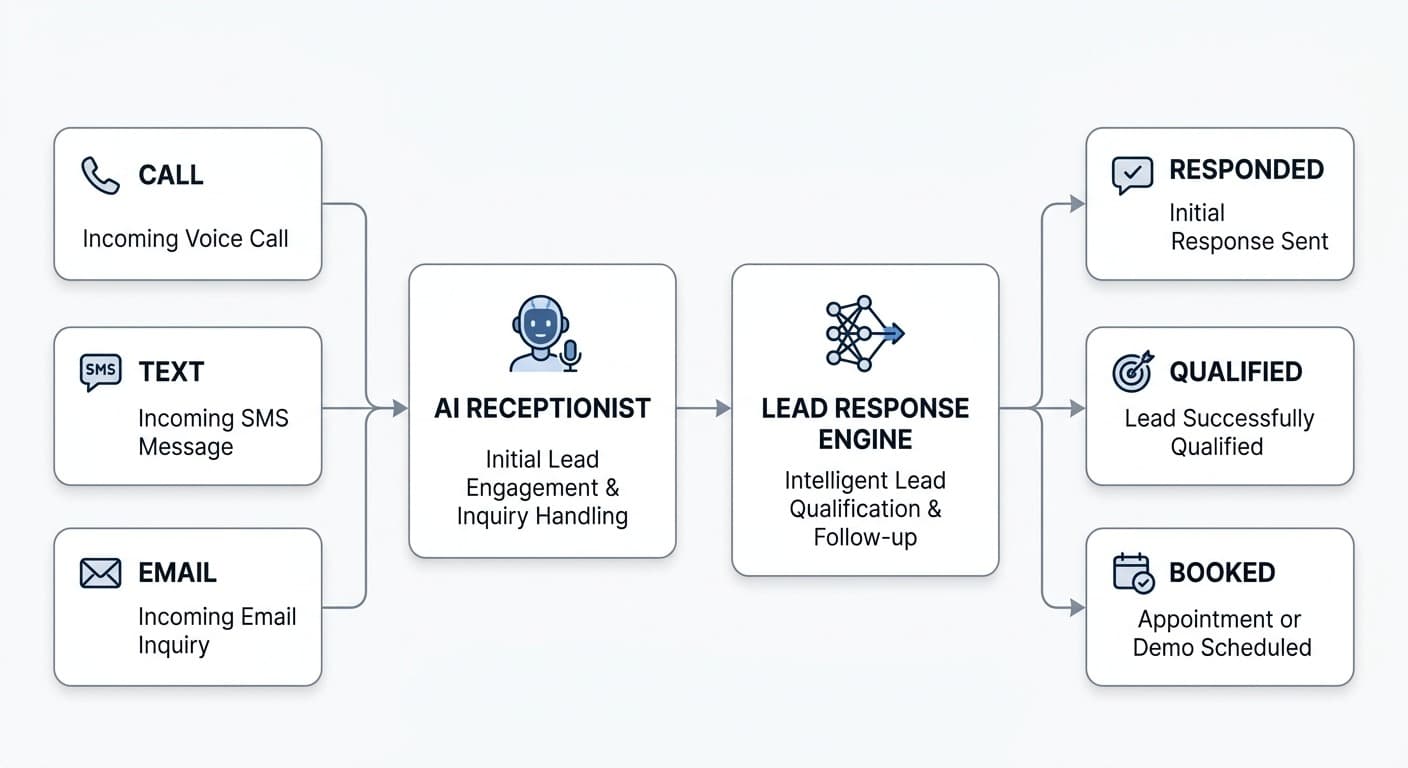
Clickmasters built an AI receptionist and lead response system for trades and service businesses such as plumbers, electricians and HVAC contractors. It answers the phone when the owner cannot, texts back missed calls, replies to texts and emails within seconds, qualifies the job and books it into the calendar. Emergencies go straight to a person, and every lead lands in one record with the recording, the transcript and a summary.

At a glance
the full brief.
Every fact that makes this project real: what it is, who it's for, and what's inside.
The challenge: the
job goes to whoever answers first
A plumber on a roof cannot answer the phone. An electrician under a house does not see the text. By the time they call back, the customer has rung the next name on the list.A Harvard Business Review audit of 2,241 US companies found that 23% never responded to a web lead at all, and the rest took 42 hours on average. A companion study of 1.25 million leads found that firms that tried to make contact within an hour were nearly seven times as likely to qualify the lead as firms that waited one hour longer.
Why speed to lead is hard for a small business
The owner is the receptionist.
Whoever does the work also answers the phone, so jobs and enquiries compete for the same pair of hands.
Three channels, no system.
Calls, texts and emails land in three places, and nobody sees the whole picture.
A bad answer is worse than no answer.
An AI answering service that invents a price or books a job outside the service area costs more than a missed call.
What the brief left out:
nine gaps we closed
The brief described the goal: answer leads before they go elsewhere. A product that small businesses can trust with their phone line needs nine more things, and we added each one to the scope.
The solution: an
AI receptionist that answers, qualifies and books on every channel
Seven steps, one system. Every channel lands in the same place.

Rules the AI cannot break
For texts and emails, code checks each reply against these rules before it is sent. On calls, bookings and transfers pass through the same checks, and every transcript is audited afterwards.
The Test Lab: proof before a customer calls
Forty test leads, 15 calls, 12 texts, 8 emails and 5 web forms, cover routine jobs, emergencies, price shoppers, out-of-area requests, wrong numbers and spam. Each script has an expected outcome. A test run plays them all and reports the nine measures in the results table below.
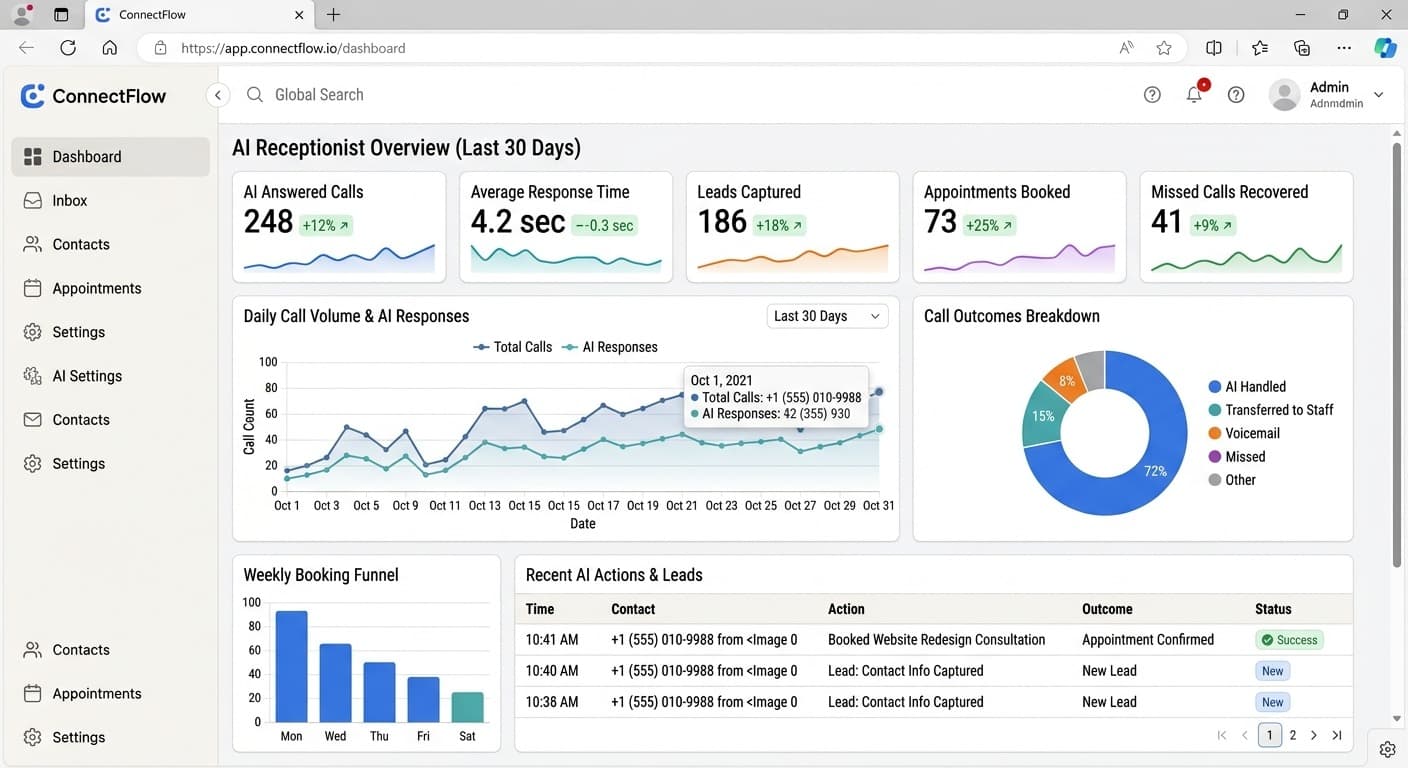
What a handled lead looks like
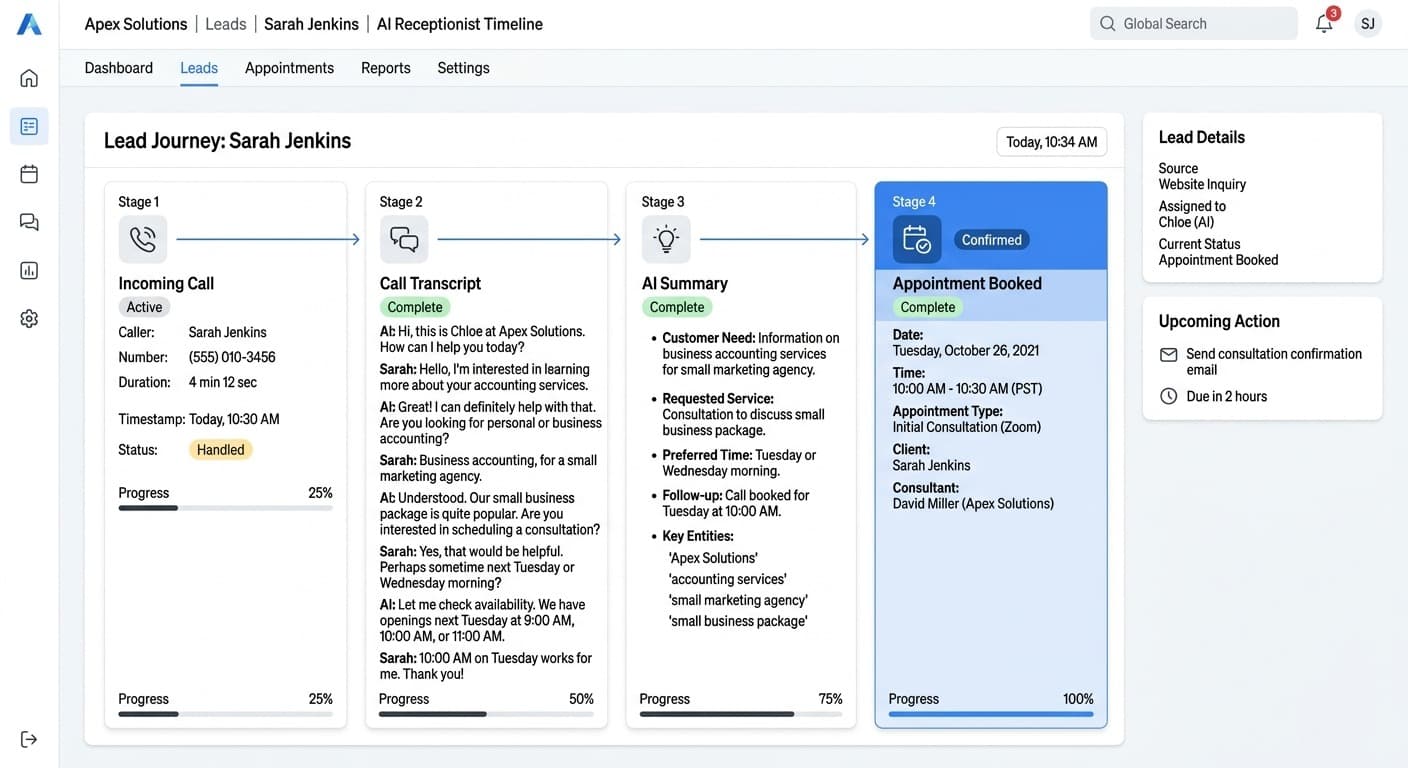
Sample for layout only. Replace these rows with a real timeline from a live session before publishing.
- 110:02:11Call
Owner's phone rings for 15 seconds, no answer
- 210:02:27Call
AI agent answers, says it is an AI and that the call is recorded; caller reports a leaking tap
- 310:04:05Call
Visit booked for Thursday at 9:00; call ends
- 410:04:09Text
Confirmation sent to the caller; summary sent to the owner
Tech stack
and open-source components
The system combines carrier and AI services with open-source parts, so the call flows, the data and the test method stay under the client's control.
Results: how fast
and how accurately the AI handled test leads
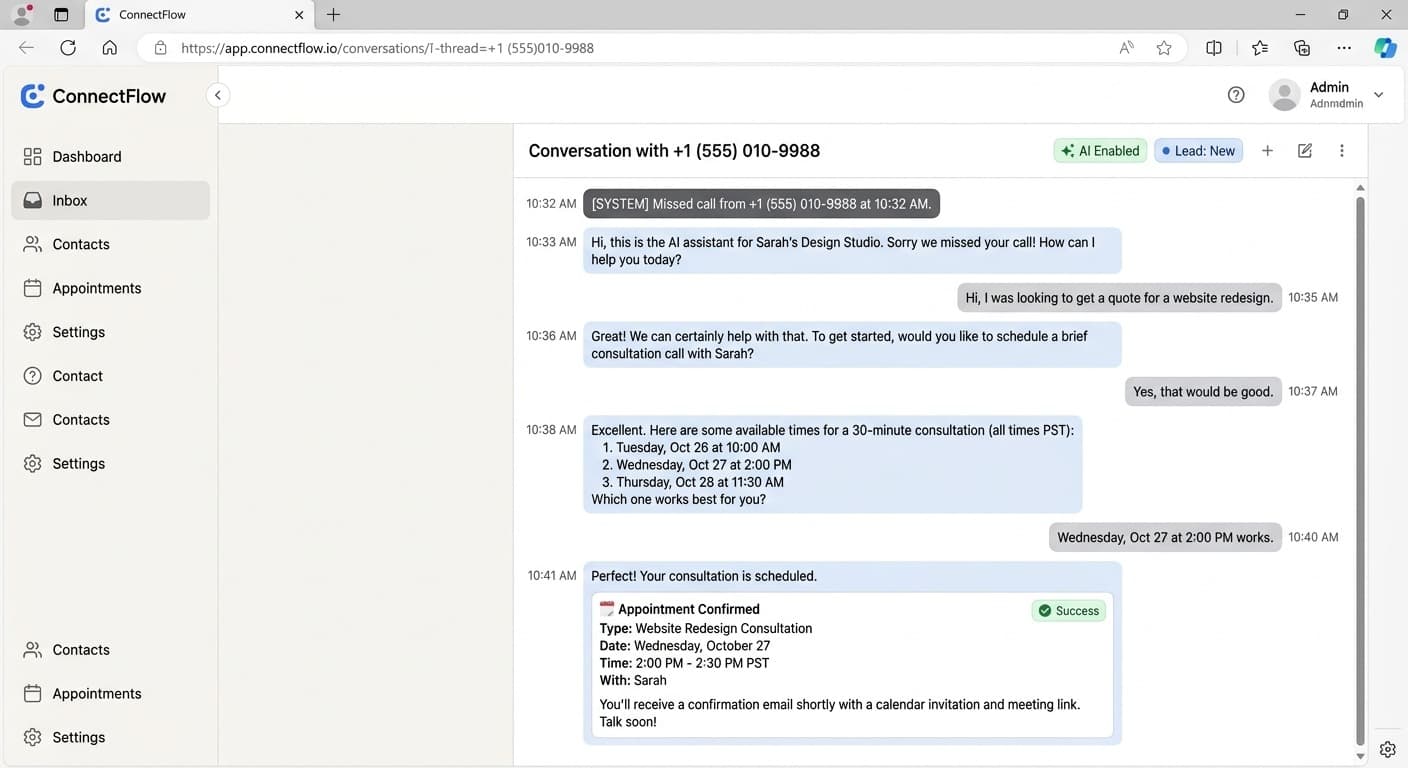
We fixed the pass thresholds before writing any code, tuned the system on 20 practice leads, then measured it on [40] test leads it had never seen.
Every value below is a threshold, not a measured number yet. Replace the bracketed values with the real numbers from the Test Lab before publishing.
Read the
full working.
Twelve parts behind the case study, from the opportunity to the sources. Pick a tab.
Case study
A Clickmasters AI Automation project for service and trades businesses: Every call, text, email and web form answered in seconds, qualified, booked, followed up and tracked to revenue. This document covers the solution design and the build. Every number in it is a target, a modelled scenario or a test result, and is labelled as such.
Document map
Twelve parts, ordered from what a buyer reads first to what an engineer builds from.
Executive summary
Service businesses lose jobs they have already paid to attract, because nobody answers the call, the text or the form in time. The AI Lead Response & Revenue Recovery Engine closes that gap. It answers every enquiry on every channel within seconds, qualifies it, books it or hands it to the right person, follows up until there is an outcome, and ties the result back to the marketing source that produced it.
The design rests on five decisions:
- One intake layer for every channel. Calls, missed calls, voicemail, SMS, email, web forms, web chat, WhatsApp and ad lead forms enter through the same gateway and land on the same record.
- Two AI agents, one brain. A real-time voice agent and a text agent share the same business knowledge, qualification rules and guardrails.
- Rules in code where it matters. Service area, opening hours, prices, consent, opt-outs and emergency routing never depend on a prompt.
- A system of record. Every lead becomes a contact, an opportunity and a timeline, with transcript, summary, score, owner and source.
- Production discipline. Queues, retries, fallbacks, monitoring, a regression suite of test leads, and a human takeover path for every conversation.
The case for speed is well documented. A Harvard Business Review audit of 2,241 US companies found that 23% never responded to a web lead and the rest averaged 42 hours. Its companion study of 1.25 million leads found that firms that tried to make contact within an hour were nearly seven times as likely to qualify the lead as firms that waited one hour longer.
Status. The solution design is complete and the build is fully specified.
The business challenge: enquiries arrive everywhere and are answered late
A service business rarely has a lead problem. It has a response problem. On an ordinary day the same company receives:
- A call while every technician is on a job, and another at 9:30 pm
- A Facebook Lead Ad submission and a website form
- A text to the office mobile, an email to info@ and a website chat message
A WhatsApp message asking for an urgent quote
Without a central system, each of those enquiries can fail in nine different ways.
Why this is revenue leakage
The business has already paid for these enquiries through advertising, SEO, reputation and referrals. Every one that is missed or answered late is revenue that was earned and then dropped.
The size of the leak is simple arithmetic: enquiries × share not answered in time × booking rate × close rate × average job value. Part 8 turns that into a transparent model with conservative, moderate and aggressive scenarios, all clearly labelled as illustrations.
The HBR figures above measured web leads at larger companies in 2011. The mechanism has not changed and applies even more sharply to a trade: the first business to hold a real conversation is in the strongest position to win the job.
Solution overview: one engine behind every channel
The engine is a lead core with channels above it and the business's own systems below it. AI agents do the talking, but they can only act through coded rules and the business's own knowledge.
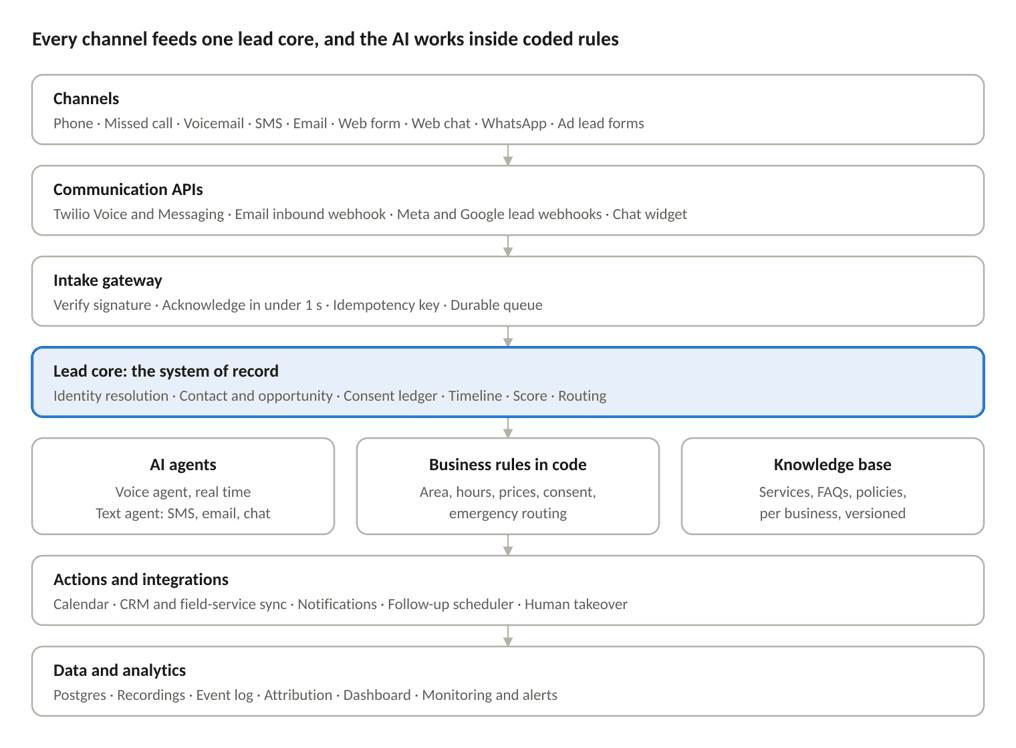
Read it top to bottom. A channel event is verified and queued, matched to one person in the lead core, handled by an AI agent, and written back to the calendar, the CRM and the analytics store. Part 3 details each agent and part 4 the stack behind each layer.
Lead lifecycle: from first contact to the next job
A lead passes through 17 processing steps, grouped here into five stages. The loop at the bottom is what turns a response tool into a revenue system.
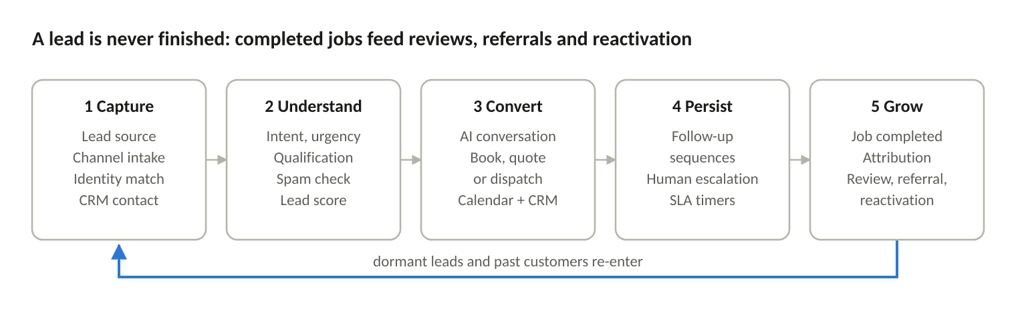
The full sequence is: lead source, omnichannel intake, identity resolution, CRM contact, intent detection, qualification, urgency detection, spam detection, lead scoring, AI conversation, the booking, quote or dispatch decision, calendar and CRM integration, automated follow-up, human escalation, conversion, attribution and analytics, then reactivation, review and referral.
Before and after
Implementation roadmap
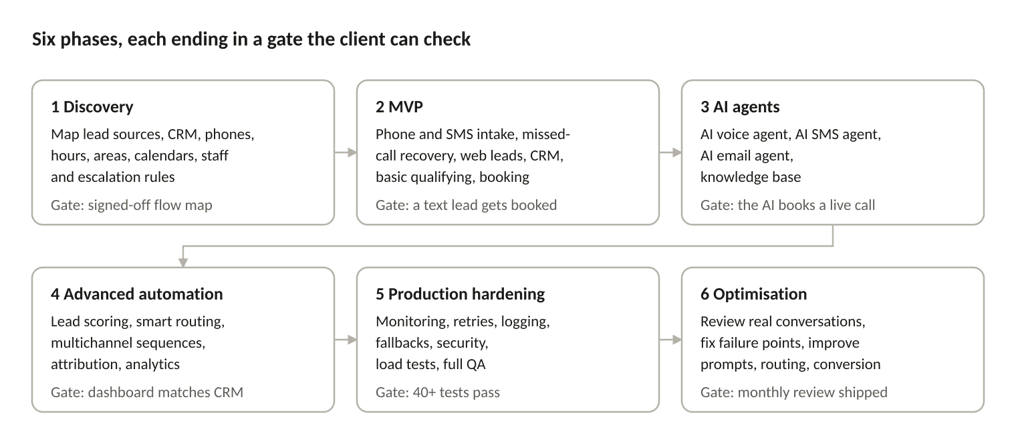
Each phase ships something a business can use, so value does not wait for phase 6. Indicative durations are in part 2, and the phase 1 discovery checklist covers ten items: lead sources, current CRM, phone system, business hours, service areas, qualification logic, calendars, staff, escalation rules and compliance requirements.
What Clickmasters delivers
The engagement covers 22 deliverables in six groups.
Why Clickmasters
We would rather show the working than make the claim, so this section is short.
- One team for the whole funnel. Clickmasters is a 13-year-old digital agency and software house. The people who build the automation also run the SEO, paid media and CRM work that produces the leads.
- Engineering before prompts. Decisions live in code, every step has a failure path, and test leads are replayed before any change goes live.
- Honest numbers. Targets, modelled scenarios and test results are labelled as such.
- A build path, not a slide. Part 9 is a specification our developers can start on tomorrow.
Conclusion
A missed call is not a telephony problem. It is a revenue-operations problem that happens to start on a phone.
This engine treats lead response as infrastructure: capture every enquiry, decide in code and tested prompts, act in the systems the business already uses, record every step and prove the result. The next step is the build in part 9, a number that anyone can call.
Frequently
asked questions
Straight answers, no marketing fluff.
What is an AI receptionist?
An AI receptionist answers a business's calls, texts and emails automatically, in natural language. It answers questions from the business's own information, takes the caller's details, books appointments and passes urgent matters to a person.
How fast should a small business respond to a new lead?
As fast as it can. Harvard Business Review research found that firms that tried to contact a web lead within an hour were nearly seven times as likely to qualify it as firms that waited one hour longer. This system replies to texts within seconds.
What is missed-call text-back?
When a call goes unanswered or the caller hangs up, the system sends a text within seconds asking what they need. The conversation continues by text, so the lead is not lost to the next business on the list.
Will callers know they are talking to an AI?
Yes. The agent says it is an AI assistant at the start of every call and whenever it is asked, and it says the call is recorded. A caller can ask for a person at any time.
What happens when a caller has an emergency?
Each business sets its own emergency rules. When a caller describes one, the agent stops qualifying, transfers the call to the on-call number and sends an alert with a summary.
How much does an AI phone agent cost per call?
By our estimate, a three-minute call costs roughly 15 to 20 US cents in AI and carrier fees on a US number at October 2026 rates. Texts and emails cost less. The measured figure from our test run is in the results table.
Does it work with my existing phone number and calendar?
Yes. The business keeps its number and forwards unanswered calls to the AI, or moves the number across. The system books into Cal.com, and Google Calendar or a job-management tool can be connected instead.
Does an AI receptionist work outside the United States?
Calls work on local numbers in many countries. Texting rules differ: the US requires carrier registration, and New Zealand requires a dedicated short code that takes five to six weeks to set up. We plan the sender setup for each country before launch.

Want every lead
answered in seconds?
Book a free automation audit. We will map how calls, texts and emails reach your business today, show you where leads leak and estimate what an AI receptionist would cost per lead.
AI voice agents · AI lead generation · AI chatbots · AI voice agents for construction and trades